
Strategy document
Arts and culture strategy
Published 18 August 2025
Foreword
It is with great pride that I introduce our Arts and Culture Strategy for 2025–2030, a renewed commitment to creativity, community, and cultural vitality across our borough.
Over the past five years, we have witnessed the resilience and ingenuity of our local arts sector. From the challenges of a global pandemic to the pressures of a cost-of-living crisis, our artists, organisations, and volunteers have continued to inspire, connect, and uplift. Through targeted investment, such as the Welcome Back Fund and the UK Shared Prosperity Fund, we have supported new events, revitalised public spaces, and launched initiatives like the Creative Communities Grant to widen access and participation.
This strategy builds on that momentum. It recognises that arts and culture are not luxuries, but essentials: they enrich our lives, strengthen our communities, and contribute to our economic wellbeing. Whether through music, theatre, visual arts, heritage, or digital innovation, creativity helps us tell our stories, celebrate our diversity, and imagine better futures.
I am most excited about Creative Maidstone, a dynamic, fun, and inspiring space for arts and creativity in Maidstone town centre, providing low-cost studios, exhibition, and retail space to support the local creative sector, as well as meeting rooms and a social space for use by the whole community. This is an ambitious project that puts together all the best elements we have seen in other spaces in Kent to create a fully supported venue for artists in Maidstone.
Our vision is ambitious. We want to ensure that everyone—regardless of background or postcode—can access, enjoy, and shape the cultural life of our borough. We will continue to champion local talent, nurture creative enterprise, and embed arts and culture into the heart of our regeneration, health, and education agendas.
I invite you to explore this strategy, to see what we’ve achieved, and to join us in shaping what comes next. Together, we can ensure that our borough remains a place where creativity thrives and culture belongs to everyone.
- Cllr Stephen Thompson
Introduction
Much has changed in the world since our original Strategy was published in early 2020. A global pandemic followed by a cost-of-living crisis has put immense pressure on local arts organisations, many of whom were already struggling to survive. Despite this, we are fortunate to still have a strong arts scene in Maidstone.
There have been welcome injections of funding from central Government, initially through the Welcome Back Fund, which enabled us to deliver a series of projects to reinvigorate the town centre. This was followed by the UK Shared Prosperity Fund, some of which we were able to utilise to develop larger-scale events and a Creative Communities Grant scheme to widen our support for local arts and cultural groups and practitioners.
We have made a strong start in supporting the local creative sector over the last five years (see ‘what we have achieved so far’). But there is still more to do, and we have ambitious plans for the next five years, which reflect the importance of arts and creativity to our society, economy, and overall health and well-being.
Arts and culture
Arts and culture mean different things to different people, making them hard to define. They can include but are not limited to: museums and historic buildings, libraries, galleries, theatres, cinemas, music, dance, drama, visual arts, crafts, digital media, photography, literature, and festivals.
For the purposes of this strategy, we have adopted a broad definition that encompasses the professional, community, and voluntary creative sectors.
Why art and culture is needed
Arts and culture have the potential to deliver wide-ranging benefits to our economy, our society and the health and wellbeing of our residents.
Our economy
According to research carried out by Arts Council England (ACE), the Creative Industries are the fastest growing sector of the UK economy, with art and culture contributing £10.6 billion.
Culture brings around £8.5 billion to the UK, through tourism, each year. Maidstone attracts over 4.6 million visits per year, with over £304 million spent in the local economy. A thriving arts and cultural offer enhances the image of an area, helping to attract inward investment.
Our society
Participating in arts and culture can:
- help develop skills, knowledge, and academic achievement, enhancing employment prospects and offering a highly skilled workforce for local businesses
- increase a person’s confidence and self-esteem, helping them realise their potential
- help promote cultural cohesion by developing a shared sense of local identity and pride in communities
- encourage inter-generational and inter-cultural learning by acting as a window to other people’s lives, fostering greater understanding and more tolerant communities, helping to reduce racism and unintended discrimination
- break down barriers between ethnic, religious, and other minority groups
- help to reduce crime/fear of crime by providing meaningful activity and strengthening community networks
Secondary school pupils engaged in arts and culture are twice as likely to volunteer in the community and are 20% more likely to vote as young adults (ACE research). Children from low-income families who take part in arts activities at school are three times more likely to get a degree (ACE research).
Our health and wellbeing
There is a significant body of evidence to suggest that access to, and participation in, arts and culture can have a positive influence on both our physical and mental well-being:
- almost 60% of people are more likely to report good health if they’ve attended a cultural place or event in the last 12 months (ACE research)
- singing, dance and drama can improve physical health through increased exercise, better breathing techniques, and posture
- dancing can help with falls prevention in the elderly
- singing has been shown to have positive effects on those living with dementia, Parkinson’s, and depression
- participation in arts and cultural activities can reduce social isolation
- social prescribing is becoming established as an acceptable alternative to medical interventions for some conditions, with more GPs now choosing to prescribe participation in arts and culture for certain patients
What we have achieved so far
Our first Arts & Culture Strategy was created with a bold vision to make Maidstone a vibrant multi-cultural hub where everyone can experience great arts and culture, and to enrich all residents' lives.
With an initial two-year action plan in place, we set out to deliver a varied programme of events and activities. The pandemic may have delayed a few things, but as we came out of lockdown, we were able to utilise Government funding, initially through the Welcome Back Fund, to start fulfilling some of our aims and objectives. Thanks to continued internal investment, and more recently with additional funding from the UK Shared Prosperity Fund, we have been able to achieve even more.
We have delivered:
- over 70 community arts and crafts workshops
- 19 music concerts and events
- Medieval Fayres
- eight town centre events (including parades and entertainment)
- four town centre trails
- a new art competition based on Mote Park, including an annual exhibition of shortlisted entries
- a ‘Hidden Histories’ project in Mote Park, including a community archaeological dig
- annual Heritage Open Days events
- 19 outdoor theatre performances, delivered in locations across the borough
- 12 new permanent artworks, including the Maidstone East Station Iguanodon, the Magical Beasts trail, and the bus station mural
- 15 temporary artworks, including vinyl wraps for empty shops in Week Street and elsewhere in the town centre, all devised and created with the local community
- a new ‘Maidstone Trails’ digital app that is free to download and helps residents and visitors explore Maidstone in more detail
We have developed and launched a bespoke website for the local creative sector, featuring an online directory with over 90 arts/cultural groups and organisations currently listed. We have also supported:
- The Heart of Kent Hospice Elmer Trail, 2021
- The Maidstone Light-Up Festival, 2022 & 2025
- Shaun the Sheep in the Heart of Kent Trail, 2024
- Annual Lunar New Year Celebrations
- Maidstone LitFest
Thanks to the UK Shared Prosperity Fund, we were also able to set up the ‘Creative Communities Grants’ scheme. Over £90,000 of funding was awarded through 7 rounds of grants, between 2022 and 2024.
In total, 43 individuals and organisations have been awarded funding, delivering 64 projects for the local community as a result. These projects have engaged 7,835 people as direct participants, with a further 27,900 audience members so far. 20 projects are still to be completed. Over 2,000 people have directly participated in these events/activities, with over 18,000 people enjoying them as audience members.
Scope of strategy
This strategy focuses on the delivery of cultural and arts projects and events in our borough over the next five years.
Maidstone Museum is the subject of a separate Transformation Plan and is therefore not included in the scope of this strategy. But there are clear synergies between the development of the museum and arts and culture in the borough.
We are responsible for the operation/management of a small number of facilities and venues in the borough. This includes the Hazlitt Theatre, Kent Life, Mote Hall, and certain community centres. However, most venues are independent, and we will therefore need to maintain strong partnerships with all providers of arts and culture. We will also need to work with colleagues across the Council to deliver the action plan. Other key partners will include the NHS, Kent County Council, and our parish councils.
This strategy sits within a wider national and regional framework, as well as the Council’s own Strategic Plan.
We have consulted with key stakeholders, including cultural and arts organisations currently active in the borough, and individual artists and makers, via bespoke questionnaires, which were carried out in February 2025. We also held two Focus Groups in March 2025, where 17 residents took part in discussions and shared their views on the future provision of arts and culture in the borough.
National context
Arts Council England (ACE) published its ten-year plan, ‘Let’s Create,’ in January 2020. This is built around three key outcomes:
Creative people
Everyone can develop and express creativity throughout their lives.
ACE will work to help communities design and develop more opportunities for creativity and better signpost those that already exist. They will encourage more museums, libraries, and arts organisations to use their collections, knowledge, skills, and resources in their work with communities to provide more activities that allow people to develop their creative potential.
This outcome includes a particular focus on young people, and specifically early years. Therefore, ACE will support libraries and cultural organisations, community partners, and the public to co-design and deliver an improved programme of creative activity for young children and their families.
Cultural communities
Villages, towns, and cities thrive through a collaborative approach to culture.
Over the next decade ACE will work with a wider range of partners, including the other National Lottery distributors, local government, further and higher education and schools, healthcare providers, the criminal justice system, the voluntary sector, the commercial creative industries and wider business, to support communities to use creativity and culture to create thriving places to live, work, study and visit.
This will only be possible if there is a shared commitment to removing the geographic, economic, and social barriers that currently prevent many people from taking part in publicly funded cultural activity.
A creative and cultural country
England’s cultural sector is innovative, collaborative, and international.
The cultural sector already acts as an incubator for the commercial creative industries: spotting and growing talent and undertaking early development of new content and services. ACE intends to deepen those connections, supporting the creative industries to build our international reputation for creativity and act as an ever-more-important engine for our country’s economy.
ACE wants to work in partnership with further and higher education and the commercial sector to strengthen training opportunities so that more people working in the cultural sector become ready adopters and developers of new technologies. They believe this will increase the adaptability of people coming into creative careers, supporting them to move back and forth between the publicly funded cultural sector and the commercial creative industries, circulating knowledge and skills as they do so.
Regional context
Kent County Council’s cultural strategy ‘Inspirational creativity: transforming lives every day – our cultural ambition for Kent’ sets a regional context, and we will contribute to its three intentions.
Create
Supporting and enabling the presentation of excellent work and the growth of world-class creative productivity.
“The creation of excellent cultural product is at the heart of everything we do. Bold and experimental art encourages people to take part and helps us to build a reputation as a dynamic county that provides rich cultural experiences for every person as part of their everyday lives.
“A strong cultural infrastructure is vital to the production and presentation of excellent work and has a number of essential elements, which go beyond our networks of venues, heritage locations, natural environment, and technology. It includes people, collaboration, creativity and networks, which collectively form an ecology that supports delivery of high-quality arts and cultural experiences.
Creating the right kind of workspace is also critical – from artists’ studios to large-scale production hubs.”
Innovate
Developing original and creative ideas, encouraging creative leadership, and supporting skills and learning.
“Success is dependent upon initiating and embracing innovation and creating the space for experimentation. With the growth of new communities and creative clusters throughout Kent, it is vital that we encourage and nurture creative ideas.
“Facilitating experimentation and linking with Kent’s world-class research institutions and universities will support growth and skills development. Leadership and learning are key to innovation, and we will nurture new talent, new ideas, and a highly skilled workforce.”
Sustain
Delivering access to finance, support for businesses, smarter ways of working, and empowering entrepreneurship.
“We know that a substantial proportion of the creative sector in Kent is freelance. We will review established business models and explore ways of working together to shape the sector to become more resilient. It will be a journey that realises potential, encourages collaboration, supports development, enables growth, and works towards financial stability to support a mixed economy of skilled freelancers, micro-businesses and larger companies.”
Other regional stakeholders have also produced plans that will inform and influence our strategy, including the South East Local Enterprise Partnership (SELEP), the South East Creative Economy Network (SECEN), Kent and Medway Economic Partnership (KMEP), the Thames Estuary 2050 Growth Commission, and the Thames Estuary Production Corridor.
Local context
Maidstone Borough Council’s Strategic Plan (2019 – 45) provides a clear mission: “Putting People and the Environment First.” It also sets out our priorities for the coming years, and the table below demonstrates how arts and culture can make a vital contribution to these.
| Priority | Outcomes | Role of Arts and Culture |
|---|---|---|
| A high-quality place adapted for the future | Taking action to mitigate and adapt to the changing climate, making sure the borough is resilient and continues to thrive for future generations |
|
| A high-quality place adapted for the future | Carrying out a full review and update of the existing Local Plan |
|
| Resilient communities | Recognising and respecting equality, diversity, and inclusion. |
|
| Resilient communities | Engaging effectively with marginalised communities to understand the challenges faced to improve our policy and practice. |
|
| Resilient communities | Understand and reduce poverty, supporting residents to live good, independent, healthy lives. |
|
| Fairer economy for people and planet | Regenerative town and rural strategies that balances ecology, community, and economy, providing fulfilling jobs and improving the local environment |
|
Other Maidstone Borough Council strategies and plans that relate to arts and culture include:
- Economic Development Strategy
- Heritage Strategy
- Town Centre Development Programme
- Festivals & Events Plan
- Destination Management Plan
- Community Development Strategy
- Green & Blue Infrastructure Strategy
- Biodiversity Strategy
Local analysis
In drawing up this strategy, we undertook desk research including a full SWOT analysis (Appendix 1); surveys of local arts and cultural organisations, and individual artists/makers (Appendix 2); and two focus groups with residents from across the borough (Appendix 4).
Maidstone is the County Town of Kent. It is the seat of local government and has a strong and growing economy, with a wide range of shopping and leisure facilities on offer. It has a rich history and impressive heritage assets; there is a substantial number of active arts and cultural groups, and a thriving music scene.
While the pandemic hit the High Street hard, with many retailers closing down and many units standing empty, this trend is beginning to reverse, with most retail areas starting to see higher levels of occupancy.
There is still a feeling, particularly amongst the creative community, that Maidstone doesn’t adequately celebrate its status as the ‘County Town of Kent’ and is failing to lead in areas such as arts and cultural facilities.
In the latest Residents Survey (2022), respondents were asked about their feelings of belonging in their local area. 68.75% of respondents agreed fairly or very strongly. When it comes to Maidstone as a place where everyone can realise their potential, however, only 26% agreed, with 49% neutral and 24% disagreeing.
If we are to build stronger, more inclusive communities and make the borough a place where people want to live, then we need to increase overall levels of pride and satisfaction and increase access to opportunities. We aim to do this by creating a more distinct identity, particularly for urban areas, and developing a sense of place for the people within them. The arts are also a known method for breaking down cultural barriers.
We want the borough to be a place where everyone can take an active part in their community and reach their full potential. Ensuring a diverse range of community activities are available and fully accessible is key to this.
To better understand how residents are currently engaging, 109 culture and arts organisations were contacted, including commercial enterprises, community groups, and voluntary organisations (full list at Appendix 2). Respondents were asked to complete an online questionnaire, and 43 meaningful responses were received (40% response rate, which is a statistically high response). Full analysis of the results can be seen in Appendix 3, but the results can be summarised as follows:
- Numbers of members/regular attendees vary from 20 or 30 people to several hundred (e.g. certain dance schools)
- The age range of participants varies depending on the activity with children and young people (aged 24 and under) tending to dominate in the performing arts and dance categories (54.2% and 42.3% respectively). There are higher proportions of older people (aged 65+) in the music (47.25%) and arts and crafts (48.2%) categories.
- Females dominate across all categories, with the highest concentration in dance (82%)
- All groups were asked to provide information on the ethnicity of their members, with the results indicating the majority of participants are white. Performing arts is the least ethnically diverse category (93.4% white) while arts and crafts is the most (85% white). According to the 2021 Census, 89.8% of Maidstone residents describe their ethnicity as white. This comprises 81.98% British and 7.82% non-British (predominantly European). The 10.19% of non-white residents comprise 2.05% Black; 4.67% Asian; 2.28% Mixed and 1.04% Other ethnic group.
While there are a lot of arts and cultural activities for residents to engage with, based on the number of members reported by respondents and weighting for non-respondents, it would appear that only around 4% of the total population of the borough is currently participating directly with an arts or cultural group.
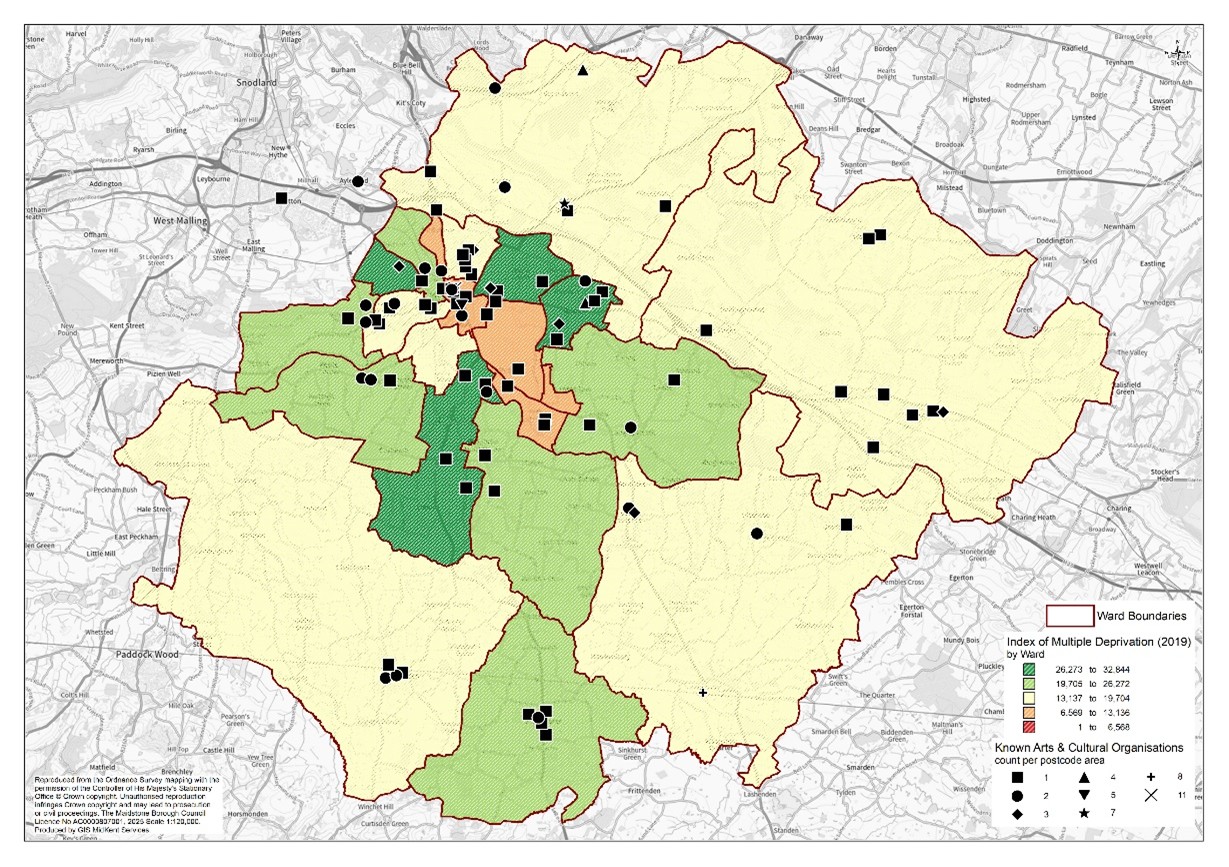
We are fortunate that the borough as a whole is relatively prosperous, but there are areas that are less affluent, where there are higher levels of unemployment, a higher proportion of low-income households, and health inequalities.
Map 1 below highlights areas in the borough which are classed as being in the most deprived, according to the Index of Multiple Deprivation (IMD), overlaid with the locations of existing arts/cultural organisations. The areas in orange have the highest levels of deprivation.
Map 1: Areas of the highest areas of deprivation in Maidstone borough:
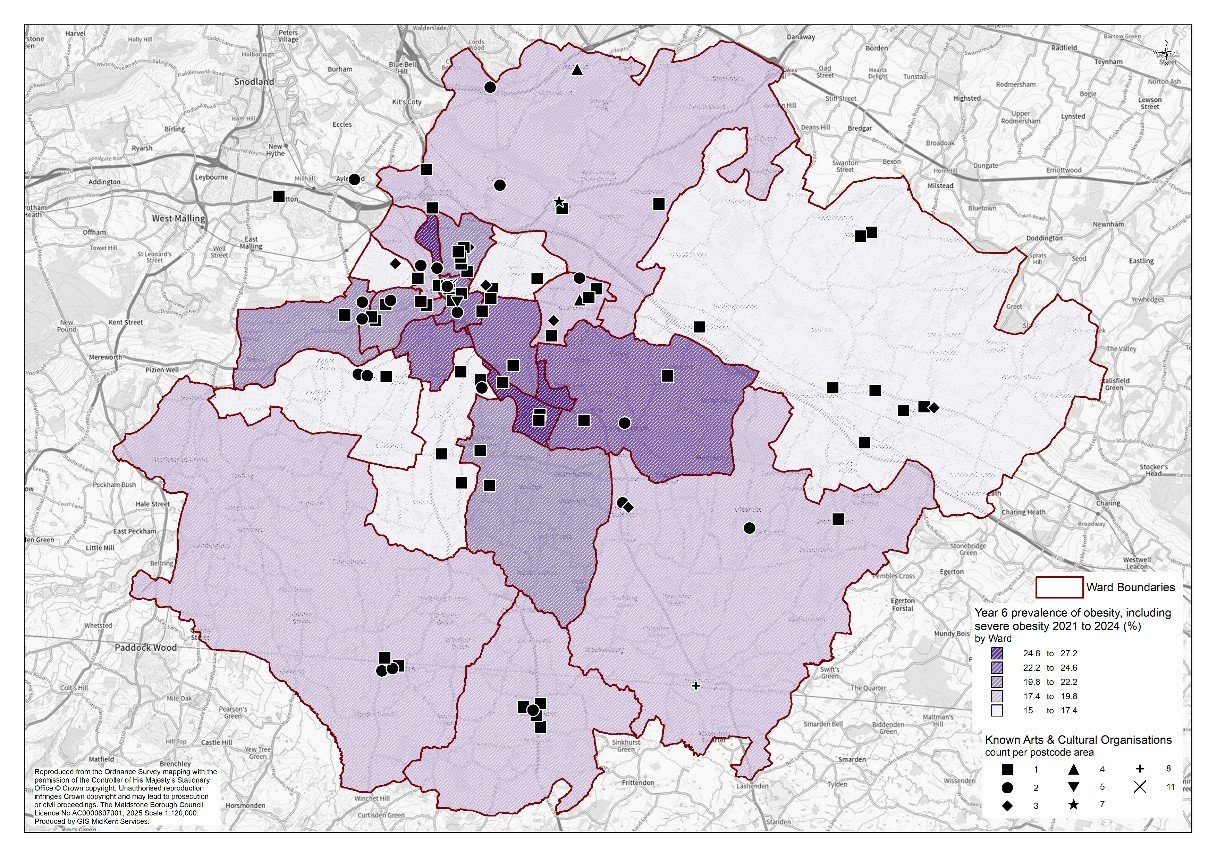
There are a number of wards within the borough that have significant health inequalities. Rates of childhood obesity are particularly high in Park Wood & Mangravet, Ringlestone, and Senacre. Map 2 below highlights these areas (darker colour) against the locations of existing arts/cultural organisations.
Map 2: Levels of childhood obesity (Year 6):
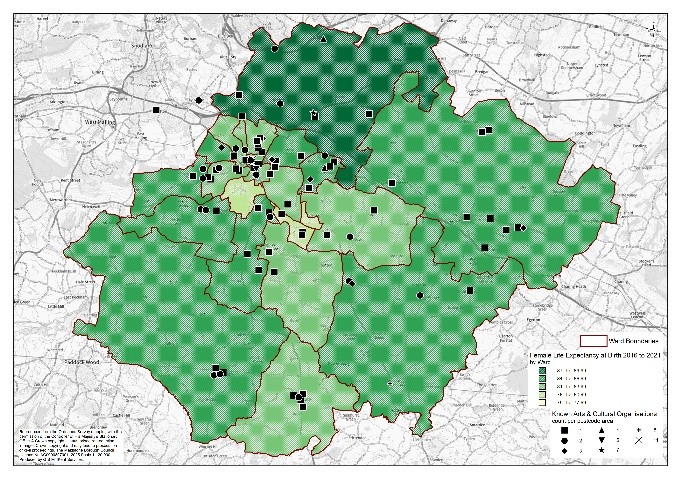
There are also discrepancies in life expectancy across the borough. These are indicated in Maps 3 and 4 below, with the lighter areas having a lower average life expectancy rate.
Map 3: Average female life expectancy:
Map 4: Average male life expectancy:
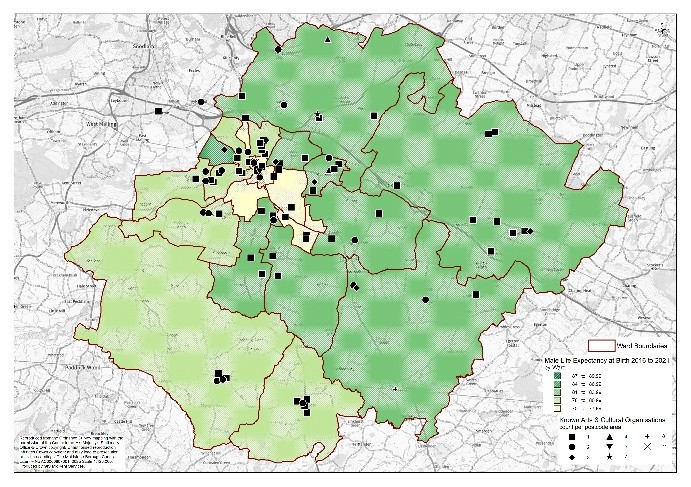
These maps indicate that some opportunities for participation in arts and culture are available within or very near to the highlighted areas, but it would seem residents are not engaging. There are likely to be a variety of barriers, both real and perceived, that limit the accessibility of these activities.
We are now undertaking a more extensive consultation with residents to better understand overall levels of engagement in a broad range of cultural activities (not just taking part in a club/society), as well as any barriers that could be preventing participation. The results of this consultation will be used to help us plan and deliver new events, activities, and arts provision across the borough. It will also help us to address any barriers to participation that may prevent residents from taking a more active part.
Focus groups
To help us understand what some of these barriers might be, we held two focus groups with members of the community. These were held in March 2025 at Fusion Café in Park Wood. Nine people attended the first session, and eight came to the second. Participants were asked three key questions.
What does arts and culture mean to you?
Participants felt that being creative is not limited to making or producing a physical object, but also includes the experience of enjoying or appreciating the creative endeavour (i.e., as an audience member). Sentiments and definitions are set out below, with the most common answers at the top of the list:
- painting
- music
- gardening
- lectures
- crafts
- history
- theatre
- lectures
- embroidery
- festivals
- plays
- street art
- writing
- art
- food
- films
- ceramics
- literature
- performances
- classical music
- poetry
- orchestra
- comedy nights
- Brenchley performances
- children’s arts and crafts
- anything that requires creative thinking
- creation of anything by an individual
- cinema
- dancing
- human activity that inspires and informs and entertains others
- dance
- places where we can learn to create or make
- musicals
- reflect our society
- pub gigs
- novels
- printing
- art exhibitions
- orchestral music
- book festival
- sculpture
- book clubs
- pub bands
- opera
- Folk Festival
- pottery
- film clubs
- singing
- hand crafts
- visual arts
- life enhancing
- textiles
- installations
- statues
- Shaun the Sheep
- bellringing
- sharing stories
- fine art
- sewing
- Blues Fest
- library
- religious events
- photography
- workshops
- acting
- using your talents
- walking
- museum
- amateur drama
- graffiti
- part of wellbeing
- performing art shows
- bookmaking
- architecture
- heritage days
- choral groups
- community choir
- bringing in an audience
- Mote Park concerts
- marching bands
- listening and enjoying
- Elmer
- music in all forms
- choral music events
- anything kind of creative making
- bandstand concerts
- being in an audience
- culture is an expression of human interaction and our need to create
What activities are available and accessible locally?
- wide range of events locally, with particular focus on music, including Brenchley Concerts, Proms in the Park, Rock the Mote, and the Mela, all spoken of positively
- Mote Hall - groups felt the atmosphere of the hall was unwelcoming and ‘felt like a school gym’; issues with heating, lighting, and acoustics
- Brenchley Gardens and Maidstone Museum are frequently mentioned, with specific reference to the Medieval Fayre, children’s workshops, painting, and bandstand concerts
- Hazlitt Theatre is considered to be small and only able to cater for certain types of performances; accessibility issues for those with disabilities, and several participants had never visited
- All Saints Church - suggested as a performance space, with installations and events similar to those held in Rochester Cathedral (e.g, Moon installation, concerts, etc); issues around access to toilets and it being a church
- ‘newer’ events (e.g, Elmer Trail, Lit Fest) are believed to be positive for the town, engaging younger people and families, and attracting visitors from outside the borough
- overall, participants felt that a lack of suitable venues locally was a key barrier to accessing Arts and Culture in Maidstone
Participants suggested that to improve its Arts and Culture offer, Maidstone would need a concert hall capable of hosting at least an 80-piece orchestra, a theatre capable of hosting/attracting a range of different performances from stand-up comedy to national touring companies, and an arts centre with exhibition and retail space for local artists. (Participants were advised of the plans for the Creative Maidstone community arts hub at the end of the session).
What are the main barriers to participation?
- aftermath of the COVID-19 pandemic is still being felt by the leisure and hospitality sector
- rise of the internet both a positive and negative allows wider access to arts and culture via online platforms (e.g. broadcasts of theatrical performances/YouTube tutorials, etc.)
- smartphone usage and shorter attention spans – competing for time
- lack of familiarity with cultural venues, uncertainty around how to behave, and a feeling of ‘it’s not for me’
- children need early exposure to feel a sense of belonging
- accessibility – both at venues (wheelchair access, facilities) and in transport. Lack of evening bus services or longer routes with convoluted journeys
- parking and congestion in the town centre
- financial – cost of living crisis impacting households and venues (additional costs often passed on to customers/participants)
The full report on the Focus Group sessions can be viewed in Appendix 4.
A wider public consultation will help to provide a more detailed picture of individual levels of engagement, including attendance at festivals and events and other forms of activity not covered in the survey (e.g. visits to art galleries, attending gigs/music events, trips to the cinema, etc). It will also help us to clarify what the main barriers to participation are for our residents, so we can work on overcoming them.
Artists and makers
To help us understand the specific issues being faced by artists and makers living and working in the borough, we sent an online questionnaire to 74 of them, and received 35 meaningful responses (47% response rate). The main priorities for the respondents are shown in the chart below.
Rank the following issues in order of importance to the continuance and growth of your creative practice.
| Issue | Ranking |
|---|---|
| Access to exhibition space | 5.42 |
| Access to retail outlets (markets, fairs, high street shops) | 4.10 |
| Opportunities to network/collaborate with other artists | 3.86 |
| Access to business support | 3.04 |
| Access to training/career development | 2.77 |
| Access to affordable studio space | 2.44 |
Suitable exhibition space and access to retail outlets continue to be a high priority. The inclusion of a new gallery and retail area at ‘Creative Maidstone’ will help to address this, as well as providing somewhere for artists and creatives to come together to network.
Economic impact
Arts and culture have a role to play in the economic success of the borough. The Creative Industries have been identified as one of eight sectors offering the highest growth opportunity in the Government’s Green Paper ‘Invest 2035: The UK’s Modern Industrial Strategy’. Maidstone currently has 615 Creative Industry enterprises, making 7.8% of all Maidstone enterprises. This is below the Kent average of 9.6% of all enterprises and the South East average of 12.1%. Kent overall has a slightly lower percentage of creative industry enterprises than the national average (10.4%)*.
In order to capitalise on the potential of this sector, we need to support our existing businesses and arts/cultural groups, while continuing to attract and retain new talent. We have a strong base within our existing creative sector and the potential offered by the new Creative Maidstone Community Arts Hub.
*ONS data compiled by Kent County Council
Employment
Using the DCMS definition of Creative Industries, the latest figures, in 2023, showed there were an estimated 8,900 jobs in the creative industries across Kent, accounting for 1.4% of all jobs. (Figures are not provided at a district level.) This 1.4% is a larger proportion than Medway (1%), but is smaller than the South-East region (2.4%) and England (2.5%)
The largest proportion of the 8,900 jobs in Kent come from IT, software, and Computer Services, making up 37.2% of all Creative Industries jobs. (Source BRES 2024).
Tourism
Arts and culture are also significant drivers for tourism. The borough is home to several high-profile attractions, such as Leeds Castle and Kent Life, and hosts a number of annual music festivals and large-scale events, including Maid of Stone and the Kent County Show. These helped to draw in over 4.6 million visitors in 2023, who spent over £304 million in the local economy.
The tourism sector supports a substantial number of jobs, both directly and indirectly, accounting for around 8% of total employment in the borough in 2023.
The Destination Management Plan (DMP) sets out the Council’s ambitions for developing and promoting the borough as a tourist destination. It recognises that arts and culture can contribute to improving the visitor experience and provide additional reasons to visit.
This strategy is therefore closely aligned to the work of the DMP, but its primary focus is on engaging residents and encouraging their participation in cultural and arts activities.
The above national and regional context, together with the local analysis, has provided the evidence to propose the following vision, priorities, and action plan.
Vision
Our arts and culture strategy contributes to achieving our overall Strategic Plan Vision: putting people and the environment first.
The vision for arts and culture is to 'make the borough of Maidstone a vibrant multi-cultural hub where everyone can experience great arts and culture, enriching all residents' lives'.
How can we deliver this vision?
Maidstone has a rich history, with impressive heritage assets and a good cultural offer. We believe there is potential to achieve much more, to make a real difference to the lives of those who live, work, and visit here. To help us realise this vision, we have identified three key priorities.
Vision 1 - cultural place-making
Increase pride in our communities through a collaborative approach to place-making; increase awareness and care for the environment.
We will achieve this by:
- 1.1.promoting, developing, and protecting the borough’s existing cultural strengths, heritage, and ecological assets
- 1.2.supporting events and activities that celebrate our shared culture and heritage
- 1.3.supporting creative businesses and events that seek to increase/enhance environmental awareness and action for change
Vision 2 - accessible by all
Ensure arts and heritage are culturally inclusive, being accessed and valued by everyone in the community, contributing to a good quality of life for all.
We will achieve this by:
- 2.1.increasing opportunities for people to experience great arts by reducing local barriers and widening participation by under-represented groups
- 2.2.working with local communities to co-create affordable and inclusive arts opportunities that address local needs, with a particular focus on areas of higher deprivation and health inequalities
- 2.3.supporting artists and organisations to inform, inspire and enable delivery of arts activities and events that celebrate Maidstone’s identity, diversity and cultural heritage
Vision 3 - sustainable
Support new and existing creative talent and cultural organisations; and champion environmentally friendly practices.
We will achieve this by:
- 3.1 supporting viable cultural organisations, creative businesses and freelancers, helping them to establish and grow
- 3.2 developing cultural venues and workspaces
- 3.3 supporting opportunities for young people to learn about and begin a creative career
- 3.4 working to reduce the environmental impact of events and activities, including:
- 3.4.1 encouraging and promoting active and sustainable travel to events
- 3.4.2 encouraging and promoting the avoidance of single-use plastics at events
- 3.5 maximising the use of new technologies to:
- 3.5.1 promote work and opportunities;
- 3.5.2 reach new audiences;
- 3.5.3 deliver innovative new arts and cultural experiences
The action plan in Appendix 5 outlines how we will work to realise these ambitions, setting out specific actions and timescales for implementation, as well as clear targets to measure our performance.
Appendix one: SWAT analysis
Strengths
- county Town of Kent
- seat of local government
- strong and growing economy
- good transport links to London and channel ports (roads better than rail)
- rich history and heritage assets:
- nationally significant complex of Grade I listed buildings centred around the Archbishops Palace
- Len House - Grade II listed Art Deco building (refurbished for mixed use)
- 2,000+ listed buildings in borough
- Maidstone Museum - internationally significant collections, 600,000+ artefacts
- Kent History & Library Centre - 14 km of historic material
- over 100 active arts/cultural groups
- key visitor attractions: Leeds Castle; Kent Life; Kent Showground; Mote Park
- thriving music scene:
- community choirs; choral societies; orchestras
- regular music festivals – Rock the Mote; Maid of Stone; Leeds Castle Classical Concert; Fringe; Vicar’s Picnic; Music on the Green etc.
- strong folk/rock scene - regular gigs in many pubs
- nightclubs host international DJs
- active night-time economy
- OneMaidstone – active Business Improvement District
- Hazlitt Theatre: platform for local amateur dramatics, dance/drama schools
- Business Terrace: growing number of creative businesses
- Maidstone Studios: hosts UCA courses in TV production
- Cohesion Plus: links to minority groups
- increasing number of informal networks like Maidstone Arts Group and the Kent Art Collective
Weaknesses
- Maidstone lacks identity:
- no unique offer
- history not celebrated
- key heritage assets are under-utilised: Town Hall, Archbishops Palace complex, Gabriel’s Hill
- riverside under-utilised:
- poor pedestrian links from town
- not well sign-posted
- little to engage visitors once there
- amphitheatre under-utilised:
- problems with anti-social behaviour
- limits on permitted sound levels (acoustic ony)
- no dedicated large-scale indoor venue for live music and other performances:
- Hazlitt Theatre only seats 350 people
- All Saints Church has good acoustics but uncomfortable seating, poor sight lines and lacks toilets;
- Mote Hall has the wrong ambience and poor acoustics
- lack of cultural diversity in arts provision
- traffic and congestion – puts people off coming into town for events/activities
- parking – cost can put people off coming into town centre
Opportunities
- launch of Creative Maidstone Community Arts Hub
- River Medway:
- utilise riverside and amphitheatre
- new Working Group
- parks and open spaces: utilise for smaller events, more local audiences
- One Maidstone: partnered projects
- increasing awareness of the importance of arts and culture on health and wellbeing (particularly mental health)
- for an ageing population – reducing social isolation
- aiding learning and educational achievement
- population growth: potential new audiences/participants for arts/cultural venues and events
- digital technology:
- reach new audiences through digital platforms and distribution channels
- create new forms of art and cultural experiences
- climate change: increased awareness of environmental issues, recycling, etc. - potential to engage new audiences
- All Saints Church – potential use as a cultural/arts venue (subject to refurbishment)
- MidKent College – looking to develop a performing arts centre to offer professional courses and training in production, lighting, performance, etc
- MEPA – looking to launch a degree-level course
- Maidstone House 4th Floor – potential as a centre for Digital Creative businesses. Possible links with the new Docking Station in Medway
Threats
- Devolution – changes to the structure of local government may have a significant impact on future funding for arts and culture
- Brexit:
- access to EU funding
- reduction in in-bound tourism
- damage to social cohesion
- lack of central government funding to support ambitious arts/cultural plans
- Maidstone not seen as a ‘priority area’ by Arts Council England, so access to their funding is more challenging
- cost of living crisis – impacts on suppliers and participants
- growth in housing development:
- increased demand on existing facilities and providers
- new communities may feel disconnected
- resentment from existing communities
- climate change:
- greater risk of severe weather events (flooding, heatwaves, unseasonal storms)
- impact on festivals and events, local infrastructure, housing, heritage, etc.
- University for Creative Arts – centre in Rochester now closed and the nearest centre in Canterbury draws students away from Maidstone
- new Docking Station ‘digital creative hub’ development in Medway
- lack of understanding of importance of arts and culture
Appendix 2: arts and cultural groups contacted
- Maidstone Wind Symphony
- Maidstone Symphony Orchestra
- Maidstone Youth Music Society
- Maidstone Choral Union
- Maidstone Singers
- Headcorn Bell Ringers
- Sutton Valence Music Society
- Sutton Valence Choral Society
- Kent Music School
- Kent County Junior Choir
- Kent County Junior Singers
- Society of Recorder Players (Kent)
- Bearsted Choral Society
- Detling & Boxley Church Choirs
- Energize Community Choir
- Friends in Harmony
- Harmony Variety Group
- Maidstone & Medway Sinfonia
- Thomas Clark Quire
- Maidstone Tuneless Choir
- Maidstone Rock Choirs
- Invicta Jazz Orchestra
- Kent Police Band
- Staplehurst Music Centre Community Orchestra
- Headcorn Ukulele Group
- Marmite Ukulele Club
- Voiceful UK
- Bloco Fogo
- Old School Samba
- Kent Chamber Choir
- Make A Noise Choir
- Hazlitt Choir
- Kettle Bridge Concertina Club
- Involve Singing Group
- Marden Bellringing
- Village Voices
- Forte School of Music
- Holy Cross Church Choir
- Maidstone Voices
- MidKent Embroidery & Textiles Group
- British Sugarcraft Guild
- Maidstone Flower Club
- Headcorn Art Group
- Harrietsham Craft & Chat
- Detling Watercolour Group
- The Maidstone Art Centre
- Invicta Photographic Club
- Staplehurst Photographic Society
- Headcorn Flower Arrangers
- The Seasons Art Class
- Maidstone Art Society
- Into the Drift
- Vanguard Contemporary Design Group
- Poets Society
- Kent Art Collective
- Hazlitt Youth Theatre
- Detling Players
- Willington Players
- Maidstone Amateur Operatic Society
- Marden Theatre Group
- Harmony Maidstone
- Maidstone Gang Show
- Kent Academy of Musical Theatre
- Theatretrain Maidstone
- Centre Stage Theatre Academy
- Theatre 2000 Maidstone
- Lenham Players
- Pauline Quirke Academy
- Hopshed Theatre Company
- Chandeliers Drama Group
- Maidstone Film Society
- Headcorn Amateur Theatrical Association
- Square Pegs Theatre
- Razzamataz
- East Sutton Community Youth Theatre
- The Heath Players
- Lenham Film Club
- Flair Performing Arts
- Contrafusion
- Lynwood Dance Academy
- Margaret Preedy Dance Studio
- Cobtree Scottish Dance Group
- JAG Dance Academy
- Hilton Hall Dance Academy
- Dance Mode
- Kent Artistic Roller Dance Club
- Elite Dance Company
- Intermission Performing Arts
- Maidstone Baton Twirlers
- Stardust Studios
- Mandy Ellen Performing Arts Academy
- Space 2 Be Me
- Maidstone Dance Studios
- Amelia Appleby Performing Arts School
- Jack Davidson Dance
- Sharon Kennard School of Dance
- Lucy Robins School of Dance
- GDC School of Dancing
- Lenham Ballet School
- Cascade Dance (Lenham Youth)
- AACTS Dance
- Dance Dynamics
- Loose Women Morris Dancing
- Weald School of Dance
- Boughton Monchelsea Morris Dancers
- Kits Coty Morris
- Maidstone Circle Dancing Group
- Best Ballroom
- Les Baton
- Michelle’s School of Dancing
- Melody Marshall School of Dance
Artists and makers contacted
- Sue Pritchard
- Janet Jackson
- Eileen Smith
- Shelley Weeks
- Catherine Metcalf
- Charlie Howden
- Joanne Weaver
- Sue J Williams
- Les Cook
- Louise Chambers
- Neil Bassant
- Dr Edward Finch (Eddy)
- Charlotte Rice-Landman
- Birgitta Wilson
- Nicole Mollett
- Carole Robson
- Clive Lennard
- Linda Simon
- Dickie Baugh
- Nelly A Harris
- Natasha
- Elke Gill
- Anne Delacour
- Brandon
- Catherine Garland
- Chris Cantrelle
- Kathy Keefe
- Kay Gretton
- Diane Sergeant
- Laura Fisher
- Janet Sturge
- Jenny Fairweather
- Laura Hollis
- Jenny Schroeder
- Linda Stymest
- John Speed
- Lynda Firth
- Pam Warner
- Lucy Hart
- Pat Fyfe
- Rif Rowland
- Antonia Enthoven
- Sara Pointer
- Sheilagh Dyson
- Cas Holmes
- Sonya Okubule
- Sue Batt
- Steve Larkin
- David Williamson
- Laura Thomas
- Clara Castner
- Alex John
- Christie Grant
- Ania
- Anne Fisher
- Kerry Ann Maxwell
- Danielle Williamson
- Esme Wells
- Jasmine Haskell
- Steven Wallis
- Stuart Ellesmere
- Jessica Goddard
- David Tovey
- Charys Beswick
- Nicola Barker
- Sarah Tille
- Gail Mercer
- Robert Montgomery
- Jan Godfrey
- Will Hepworth
- Chael Tucker
- C J Munn
- Saffiere Dunstan-Saffrey
- Nick Hampshire
Appendix three: questionnaire summary
109 culture and arts organisations were contacted and asked to complete an online questionnaire (full list at Appendix 2). 43 meaningful responses were received (40% response rate).
Key findings - geographical spread
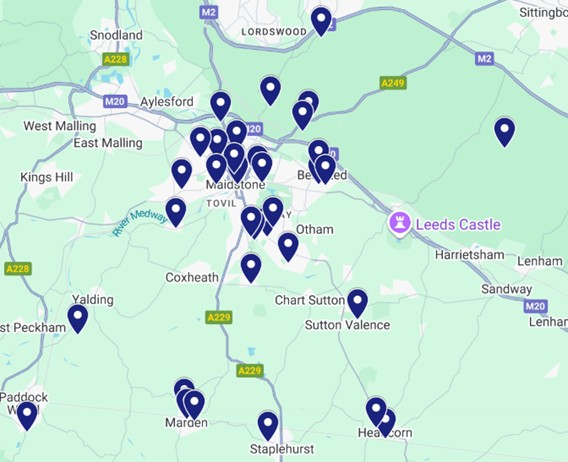
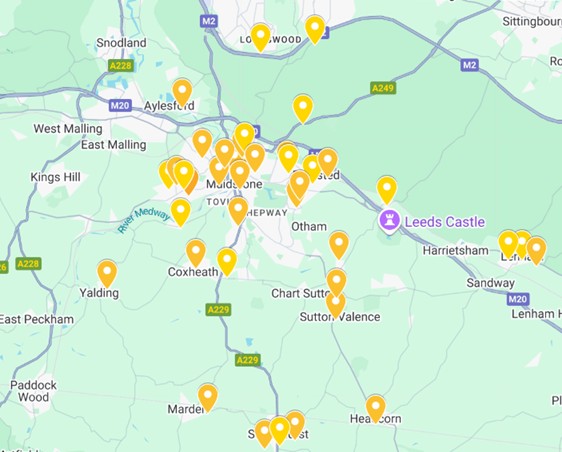
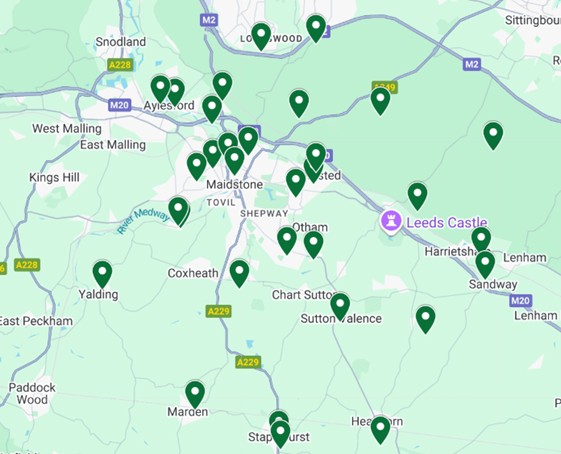
There is a higher concentration of activities within Maidstone town centre, as expected, but there is a reasonable mix of activities across the wider borough too. It should be noted that not all groups marked on the following maps responded to the survey. Where a group did not respond, the location has been taken from other sources (e.g. website/ Facebook).
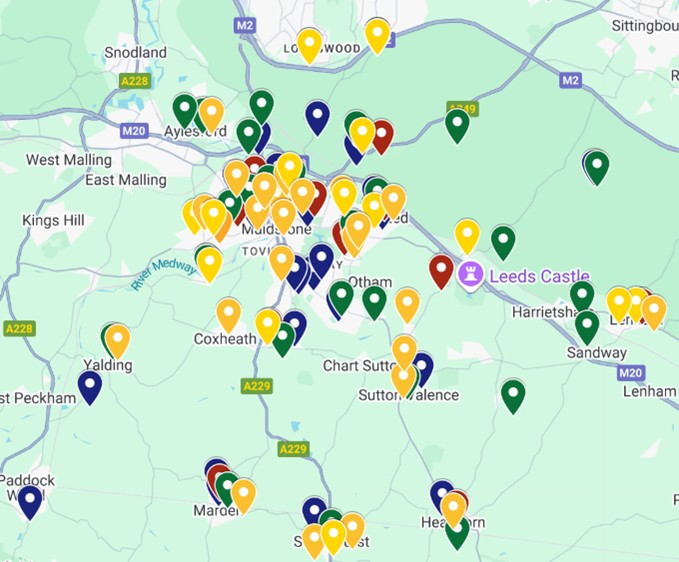
Geographical spread by category
Music groups
Dance groups
Arts and crafts groups
Theatre groups
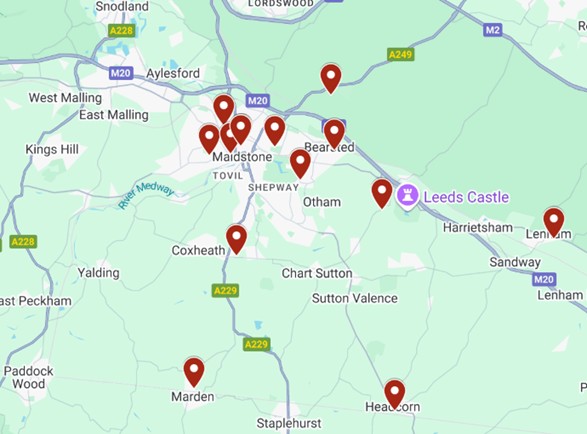
Number of members/participants per organisation/group
Some groups numbered their members in the hundreds, including several dance schools, while others have around 20 to 30 regular attendees. These figures show the average membership for each category:
- overall - 132 members
- music - 59
- theatre - 124
- dance - 137
- art and craft - 207
Age range of participants
Children and young people tend to dominate the theatre (performing arts) and dance categories while there are significantly higher proportions of older people in the music and arts & crafts categories.
| Type of group | Under 24 | 25–44 | 45–64 | 65+ |
|---|---|---|---|---|
| Music | 14% | 13% | 26% | 47% |
| Dance | 42% | 13% | 12% | 33% |
| Theatre | 54% | 14% | 17% | 15% |
| Arts and crafts | 9% | 21% | 22% | 48% |
Gender diversity
Maidstone Borough has a slightly higher percentage of residents identifying as female than male. This is reflected in the fact that females dominate across all categories, especially in dance and arts & crafts.
| Type of group | Male | Female | Other |
|---|---|---|---|
| Music | 30.8% | 68.95% | 0.25% |
| Dance | 17.2% | 82.80% | |
| Theatre | 30.1% | 68.7% | 1.2% |
| Arts and crafts | 24.2% | 75.8% |
Ethnic diversity
According to the 2021 Census, the largest ethnic group in the Maidstone borough is white. 89.8% of residents belong to this ethnic group. This is reflected in the survey responses, with arts and crafts groups being the most diverse.
| Type of group | White | Asian | Black | Mixed | Other |
|---|---|---|---|---|---|
| Music | 91.8% | 2.5% | 2.70% | 1.55% | 0.5% |
| Dance | 87.7% | 3.0% | 3.0% | 5.2% | 1.1% |
| Theatre | 93.4% | 2.2% | 2.3% | 0.8% | 1.3% |
| Arts and crafts | 85.0% | 3.2% | 4.0% | 5.0% | 2.8% |
Priorities for the future
Respondents were asked to rank the following in order of priority for their organisation/group:
- finance and accessing funding
- venues – finding suitable premises (to work, meet, exhibit or perform)
- audience development (marketing events, classes, etc)
- attracting and retaining new/diverse membership
- networking with other arts and cultural organisations in the area
| Priority | Ranking score |
|---|---|
| Attracting and retaining new/diverse membership | 3.56 |
| Finance and accessing funding | 3.29 |
| Audience development (marketing events, classes, etc) | 3.04 |
| Venues – finding suitable premises (to work, meet, exhibit, or perform) | 3.02 |
| Networking with other arts and cultural organisations in the area | 2.20 |
Appendix four: focus group sessions full report
We are in the process of drafting a new Arts & Culture Strategy for the Borough. The Strategy aims to ensure Maidstone has a vibrant cultural and arts offer that can be enjoyed by all residents, providing opportunities for everyone to explore their creativity throughout their lives, and to support local artists/makers and creative organisations.
In order to help inform the Strategy, we ran two focus group sessions. These sessions were open to everyone in the borough aged 18 years or over. Details about the project were published on the Council’s Engagement Hub ‘Let’s talk Maidstone’, and those interested in attending a focus group were invited to leave their details. The project was publicised to the Council’s consultation mailing list, which is made up of approximately 13,000. It was also promoted on the Council’s social media feeds.
A total of 21 expressions of interest were received from people wishing to participate in a focus group. All those expressing an interest were invited to attend a focus group on one of their preferred dates. The sessions were held at Fusion Café in Park Wood, and across the two sessions, there were a total of 17 participants.
What does art and culture mean to you?
First, the groups were asked to define what Arts and Culture mean to them.
In addition to specific artistic and cultural pursuits, some group members sought to define what Art and Culture are in a broader sense, with discussions focusing on what being ‘creative’ means. There was a strong sense that being creative is not limited to making or producing a physical object, but also includes the experience of enjoying or appreciating the creative endeavour, i.e., as part of the audience.
Crafts were viewed as artistic activities, and participants felt that art and craft went together, with one participant phrasing it as ‘The craft is what you use to create the art’. Participants agreed that appreciation of art and culture is subjective in terms of personal preferences and that creative and artistic experiences, both in terms of production and appreciation, had positive impacts on people’s well-being.
Sentiments and definitions are set out below, with the most common answers at the top of the list:
- painting
- music
- gardening
- lectures
- crafts
- history
- theatre
- lectures
- embroidery
- festivals
- plays
- street art
- writing
- art
- food
- films
- ceramics
- literature
- performances
- classical music
- poetry
- orchestra
- comedy nights
- Brenchley performances
- children’s arts and crafts
- anything that requires creative thinking
- creation of anything by an individual
- cinema
- dancing
- human activity that inspires and informs, and entertains others
- dance
- places where we can learn to create or make
- musicals
- reflect our society
- pub gigs
- novels
- printing
- art exhibitions
- orchestral music
- book festival
- sculpture
- book clubs
- pub bands
- opera
- Folk Festival
- pottery
- film clubs
- singing
- hand crafts
- visual arts
- life enhancing
- textiles
- installations
- statues
- Shaun the Sheep
- bellringing
- sharing stories
- fine art
- sewing
- Blues Fest
- library
- religious events
- photography
- workshops
- acting
- using your talents
- walking
- museum
- amateur drama
- graffiti
- part of wellbeing
- performing art shows
- bookmaking
- architecture
- heritage days
- choral groups
- community choir
- bringing in an audience
- Mote Park concerts
- marching bands
- listening and enjoying
- Elmer
- music in all forms
- choral music events
- anything kind of creative making
- bandstand concerts
- being in an audience
- culture is an expression of human interaction and our need to create
Across both sessions, participants agreed that there was a lot of history in Kent and Maidstone, including buildings and spaces that could be used for creative and artistic pursuits. Locations such as the Archbishop's Palace, Mote Park, All Saints Church, and the Museum were specifically mentioned.
When broaching the topic of culture, there was less enthusiasm and interaction on this. Participants referenced specific groups (such as Gurkhas and Gypsy, Travelers and Travelling Show people) having their own culture; however, there was no mention of specific cultural activities or events relating to these groups apart from the Mela. It was suggested that there should be a programme of cultural events throughout the year catering towards Maidstone’s minority ethnic communities.
There was also a general feeling that many of the existing music events in Maidstone were not attractive to young people.
Discussions turned to Maidstone Town Centre. Participants commented on the accessibility of the Town Centre, stating that there is a lack of public transport and that the congestion was ‘off-putting’. There were also comments about the look and feel of the Town Centre, with one saying that some places were ‘bland and soulless’.
What activities are available and accessible locally?
The groups considered what activities were available locally within Maidstone and what was missing. Rather than focusing on specific activities, the majority of participants considered venues and spaces that are available for activities to take place in.
It was noted that there is a wide range of events locally, with a particular focus on music. Specific reference was made to Brenchley Gardens concerts, Proms in the Park, Rock the Mote, and the Mela. These events are all held in parks and are spoken of positively. There was a suggestion that Whatman Park was underutilised.
The United Reform Church was identified as a music performance space, though some felt that, due to it being a church, this could put some people off attending a performance here.
Mote Hall was also mentioned as a performance venue, with comments that it has held music concerts, including classical and pop, and stand-up comedy (Jimmy Carr). However, groups felt the atmosphere of the hall was unwelcoming and ‘felt like a school gym’. Issues with heating, lighting, and acoustics were also mentioned in relation to Mote Hall. Several participants suggested that rather than go to Mote Hall to see a performance, they would prefer to venture outside the borough.
In terms of other venues, the Colyer-Fergusson Music Building was mentioned by several participants. This is a purpose-built, flexible performance space at the University of Kent in Canterbury with dedicated rehearsal and performance spaces. This venue was highly thought of by those who were familiar with it. In particular, participants were positive about its capacity for performance and audiences as well as the acoustics.
Brenchley Gardens and Maidstone Museum were frequently mentioned as venues for Arts and Culture activities, with specific reference to events such as the Medieval Fayre, children’s workshops, painting, and bandstand concerts. Participants were aware of activities being run specifically for children during school holidays, but there was little discussion around activities for teenagers and young adults (up to 24 years). However, it was noted that local schools offer a wide range of extracurricular activities and put on their shows and exhibitions.
Participants expressed disappointment that the Museum no longer had a café. They felt that this would encourage people to spend longer at the museum and use it as a place to meet more generally. Participants suggested using a café for lectures in the evening or hiring it to local arts and craft groups to increase footfall at the museum and raise the profile of smaller artistic groups. Positive community impacts of this, such as reducing isolation and improving mental health, were also mentioned.
Very little was said about the Hazlitt Theatre compared to other types of venues discussed. This is perhaps significant considering it is Maidstone’s one and only theatre. Participants considered the theatre to be small and only able to cater to certain types of performances.
It was noted that there are accessibility issues for those with disabilities, and several participants said they had never visited the Hazlitt. The proximity to London was seen as a setback to attracting audiences and shows to Maidstone. The Marlow Theatre at Canterbury was highlighted as a good venue.
Some group members were aware of the Amphitheatre by Millennium Bridge, referring to it as ‘underused’. This awareness came about through the Shakespeare sessions held here in the summer and children’s holiday activities. Overall, it was not considered a good venue, with access issues for people with poor or limited mobility and a lack of toilet facilities.
Participants referenced the Maidstone Visual Arts Network as an example of a local group making use of local space, in this case, Maidstone Library.
There was also mention of All Saints Church being used as a performance space with installations and events similar to those held in Rochester Cathedral (Mars & Moon installations and concerts). Issues around access to toilets (none within the church itself) and it being a church were raised regarding this venue.
There were queries from the groups about the Archbishop's Palace. Many said they would like to see this space open to the public and given a new lease of life. However, many said they had never been inside this building, so they were unaware of the restrictions around its listing as a heritage building.
Participants commented that ‘newer’ events such as the Elmer Trail and Lit Fest had been positive for the town, engaging younger people and families, and attracting visitors from outside the borough.
In terms of more cultural activities and events, attendees mentioned the Mela, LitFest, Chinese New Year Celebrations, and Holi (Hindu Festival of Colours).
Artists and makers within the groups were concerned about the lack of spaces to sell artwork. It was noted that Maidstone Market regularly holds a craft fair, and there are sometimes events at Detling Showground. Makers told us that these events attract different types of audiences and that stands at larger shows, such as Detling, can be too expensive for less established artists and makers. The consensus was that Maidstone needs a dedicated space for selling and promoting local artists. This could be a separate space or incorporated into a wider Arts Centre, i.e., with gallery/exhibition space.
One group identified four key elements for improving access to Arts and Culture in the borough. These were:
- a visual arts venue to exhibit
- a dedicated performance space
- flexible and accessible venues
- a meeting space for young people to develop creativity/performance
Overall, a lack of suitable venues locally was seen as a barrier to accessing Arts and Culture in Maidstone by both the residents and makers who attended the sessions.
Participants suggested that to improve its Arts and Culture offer, Maidstone would need a concert hall capable of hosting at least an 80-piece orchestra, a theatre capable of hosting/attracting a range of different performances from stand-up comedy to national touring companies, and an arts centre with exhibition and retail space for local artists.
More broadly, some participants felt that if there were enough people interested in a particular activity, they would form a group/network themselves. There was a suggestion that there could be more support for people who want to set up their interest groups.
Barriers to participation discussion
The groups discussed barriers to participation. There was some discussion about how the COVID-19 pandemic and the resulting changing nature of society have impacted people’s access to arts and culture. It was noted that generally, the leisure and hospitality business had not recovered since the pandemic and was still seeing a downturn in footfall and cuts to funding in the sector.
There was discussion around how some people are ‘scared to go out’ and about the amount of abundance of entertainment that is available at home. The rise of the internet was seen as both a help and a hindrance to arts and culture in society. Concerns around smartphone usage and short attention spans were mentioned. The internet was also seen in a positive light in terms of making arts and culture more accessible to a wider audience, for example, with the National Theatre performances being shown online/on TV, and YouTube videos of people sharing and teaching their crafts. Events being recorded and shared online, if the event is at a time that isn’t convenient, was also seen as a positive.
A sense of belonging emerged as a barrier to participation, with some thoughts about familiarity or knowledge of the art or culture, and Intimidating venues exacerbated feelings of not fitting in. It was felt that certain cultural activities were seen as ‘highbrow,’ which could be off-putting for some, as they may feel like they do not belong. Early exposure to a wide range of arts and cultural activities was thought to be key in fostering a sense of belonging and inclusion from a young age.
Following the focus group, further information was received from one participant in regard to young people. Their child (a teenager) expressed a desire for more in-depth knowledge around cultural history, which could be delivered via a lecture programme. It was felt that there is a gap between activities for primary school-age children and adults that is not currently being met.
Accessibility was identified as a barrier not just in terms of venues, i.e., wheelchair access and changing places, but also in terms of transport. Participants mentioned being unable to use public transport in the evening as services did not run or had long routes, leading to convoluted journeys or excessive travel times. Parking and congestion in Maidstone were also viewed as a barrier when visiting the Town Centre in particular.
The cost-of-living crisis was highlighted as another barrier to participation. Groups mentioned how household budgets had been squeezed with no additional funds for arts and culture activities. This was also an issue for people running events and workshops, with some venues increasing their hire charges to cover increases in energy costs. Price increases in materials were also highlighted, as was the wider associated cost of attending an arts or culture event, e.g., petrol, parking.
The groups queried how we publicise our events. It was explained that there is a mailing list people can sign up to in addition to a dedicated website, ‘Visit Maidstone’, the Borough Insight magazine, poster sites in and around the Town Centre, and our social media feeds.
Participants queried whether we could be more proactive by producing an online publication to highlight arts and culture activities and events. It was suggested that this could support smaller, grassroots/community groups by giving them a bigger audience for their work. It was also suggested that arts programmes from outside of Maidstone could include Maidstone events in their publicity to attract a wider audience.
It was suggested that Maidstone should consider the work of other local authorities to gain insight into best practice for what works well regarding the promotion of arts and culture offerings. Folkestone was mentioned as an example of a local authority that had introduced provisions for pop-ups and integrated this into their retail offer. These can be hired at low cost on a fortnightly basis.
Additional suggestions
In addition to suggestions noted throughout, several other ideas arose from the sessions:
- more working with local minority groups
- mixed art collaborations
- more short courses and lectures
- establish Art/Music College
- Street Art Town Trail
- Blues & Jazz festival
- make better use of the river
Appendix five: action plan
Priority: cultural place-making
| Objective | Item | Action | Target | Timescale | MBC Strategic Plan priority | Approximate costs |
|---|---|---|---|---|---|---|
| 1.1 | 1 | Support the museum with the delivery of events/activities, ensuring synergy of plans and collaboration where appropriate | Ongoing collaboration | Ongoing | A High Quality Place | Officer time |
| 1.1 | 2 | Continue to support and promote venues across the Borough taking part in Heritage Open Days | At least 6 venues take part in HODs. | Annual (Sept) | A High Quality Place | Officer time |
| 1.1 | 3 | Develop and deliver MBC activities for Heritage Open Days (including Town Hall tours, Mote Park walks, and new initiatives) | At least 3 MBC events delivered each year | Annual (Sept) | A High Quality Place | £500 - £1,000 |
| 1.1 | 4 | Look for opportunities to invest in new public artworks for the public realm. | New artworks commissioned as appropriate | Ongoing | A High Quality Place | Subject to funding |
| 1.1 | 5 | Provide support to developers with public art plans for private developments where appropriate | Requests for assistance/advice are responded to within 5 days | Ongoing | A High Quality Place; Quality Homes | Officer time |
| 1.2 | 6 | Continue to deliver an annual Medieval Fayre in Brenchley Gardens; work to increase/vary offer each year | Increase footfall year on year | Ongoing (April) | Resilient Communities | £5,000 p.a. |
| 1.2 | 7 | Continue to deliver the Bandstand Concerts in Brenchley Gardens | At least 6 concerts delivered each summer | Ongoing (Jul-Sept) | Resilient Communities | £7,000 p.a. |
| 1.2 | 8 | Work with colleagues to deliver events/activities as part of Black History Month | At least 4 events/activities delivered | Annual (Oct) | Resilient Communities | £1,500 p.a. & Officer time |
| 1.2 | 9 | Work with One Maidstone to deliver a summer trail and the annual Light Up Festival | Trail installed; Light Up Festival delivered | Ongoing | Resilient Communities | £7,500 p.a. |
| 1.2 | 10 | Deliver a 3-year ‘Hidden Histories’ project in Mote Park to increase understanding and awareness of the old manor house and increase engagement in the park/heritage | 3-year programme of excavations delivered with at least 3 primary schools and 100+ residents | Jun 2026 – Jun 2028 | Resilient Communities | £180k – subject to external funding. Will not go ahead without |
| 1.2 | 11 | Develop and deliver an annual event to celebrate the town’s military history (military vehicles, music, exhibitions, etc.) | Event created and delivered | Jun-26 | Resilient Communities | £3,000 p.a. |
| 1.3 | 12 | Work with the River Medway Steering Group to deliver events/activities that promote and celebrate the riverside | At least 4 events held | Mar-26 | A High Quality Place; Resilient Communities | £10,000 (UKSPF) |
| 1.3 | 13 | Develop workshops and activities that promote the use of recycled, sustainable materials, upcycling, and reuse | All workshops utilise sustainable resources where possible | Ongoing | A High Quality Place; Fairer Economy | Officer time |
| 1.3 | 14 | Work with Biodiversity and Climate Change colleagues to deliver events that promote environmental awareness | At least 2 specific events per year | Ongoing | A High Quality Place; Fairer Economy | £500 - £1,000 (depending on event) |
Priority: accessible by all
| Objective | Item | Action | Target | Timescale | MBC Strategic Plan priority | Approximate costs |
|---|---|---|---|---|---|---|
| 2.1 | 1 | Carry out an online public consultation to identify the main barriers to participation in arts and culture | Consultation completed | Oct-25 | Resilient Communities | Officer time |
| 2.1 | 2 | Develop workshops/classes to target under-represented groups and deliver from Creative Maidstone Hub | At least 2 workshops per week targeting specific groups | Jul-28 | Resilient Communities | £5 per head for materials (average) |
| 2.1 | 3 | Continue to deliver the Mote Park Art Competition and annual exhibition | At least 100 entries per year | Ongoing | Resilient Communities | £1,500 p.a. |
| 2.1 | 4 | Support the museum team with the delivery of the biannual Young Artist Award | At least 50+ entries | Ongoing | Resilient Communities | Officer time |
| 2.1 | 5 | Continue to partner with Hazlitt Theatre to deliver a touring outdoor production each summer | At least 10 locations visited across the borough | Ongoing | A High Quality Place; Resilient Communities | £10,000 p.a. |
| 2.1 | 6 | Work to develop a ‘community mural zone’ where anyone can create artwork, within established guidelines | Location identified and guidelines approved, artworks created | Dec-25 | A High Quality Place; Resilient Communities | £5,000 (UKSPF) |
| 2.1 | 7 | Deliver a community mural project to create new murals on Fairmeadow underpass & along the riverside (St Peter’s Bridge) | New murals designed and created | Dec-25 | A High Quality Place; Resilient Communities | £15,000 (UKSPF) |
| 2.1 | 8 | Continue to support Maidstone LitFest organisers | LitFest held; increased engagement | Oct-25 | Resilient Communities | £5,000 (UKSPF) |
| 2.1 | 9 | Support Maidstone PRIDE and other minority groups looking to put on events in the borough | Annual PRIDE festival held | Ongoing (June) | Resilient Communities | Officer time; Free let of Brenchley |
| 2.2 | 10 | Deliver events/activities in Park Wood, Shepway and Tovil, working with partner organisations in each area (e.g. Fusion) | At least one activity is held in each location annually | Ongoing | Resilient Communities | £1,500 |
| 2.2 | 11 | Work with partner organisations to reach under-represented groups and engage them in activities at Creative Maidstone Hub | Good attendance at targeted activities | Ongoing | Resilient Communities | Officer time |
| 2.2 | 12 | Deliver a bi-annual Arts Carnival, working with local schools and community groups, artists, and creatives | Carnival held; at least 8 schools engaged; increased footfall | Jul-25, Jul-27 & Jul-29 | Resilient Communities | 2025: £40,000 (UKSPF); 2027/29: £20,000 |
| 2.3 | 13 | Work with partners to deliver an annual Fun Palace event; engage new artists/community groups to help deliver activities | Event held and footfall increased; 1000+ attendees | Ongoing (Oct) | Resilient Communities | £1,000 p.a. |
| 2.3 | 14 | Continue to support Cohesion Plus to deliver Lunar New Year Celebrations | Larger and more diverse audience year on year | Ongoing (Jan/Feb) | Resilient Communities | £2,500 p.a. |
| 2.3 | 15 | Continue to support Cohesion Plus to deliver the Maidstone Mela | Increased/more diverse footfall | Ongoing (Sept) | Resilient Communities | Free let of Mote Park (c. £2,000) |
Priority: sustainable
| Objective | Item | Action | Target | Timescale | MBC Strategic Plan priority | Approximate costs |
|---|---|---|---|---|---|---|
| 3.1 | 1 | Work with the Economic Development team to promote Creative Maidstone studios to local artists/creatives | At least 50% occupancy at the end of year 1 | Jul-26 | A High Quality Place; Resilient Communities | Officer time |
| 3.1 | 2 | Promote new exhibition space at Creative Maidstone Hub | At least 50% occupancy within the first year | Jul-26 | A High Quality Place; Resilient Communities | Officer time |
| 3.1 | 3 | Promote retail spaces at Creative Maidstone Hub | At least 50% occupancy within the first year | Jul-26 | A High Quality Place; Resilient Communities | Officer time |
| 3.1 | 4 | Facilitate networking and training workshops for artists/creatives renting space at Creative Maidstone Hub (with ED) | At least 3 events held in the first year | Jul-26 | A High Quality Place; Resilient Communities | £250 per session (trainer/catering) |
| 3.1 | 5 | Continue to promote the online directory for local arts and cultural clubs and organisations (commercial & voluntary) | New clubs listed within five days of application | Ongoing | A High Quality Place; Resilient Communities | Officer time |
| 3.2 | 6 | Work with Mid-Kent College and other partners as appropriate to investigate options for a new performing arts centre, to include a larger auditorium and professional training opportunities | Potential locations identified; feasibility assessed; potential funding identified | Aug-26 | A High Quality Place; Resilient Communities | Officer time |
| 3.2 | 7 | Support All Saints Church with proposals to adapt usage to include creative/cultural events and activities | New creative facilities created | Dec-28 | A High Quality Place; Resilient Communities | Officer time |
| 3.2 | 8 | Investigate opportunities to establish official busking sites at key locations in the town centre | Locations identified and a booking system developed | Sept-26 | A High Quality Place | Officer time |
| 3.3 | 9 | Increase opportunities for volunteering in the arts (through Creative Maidstone Hub) | Volunteering programme developed and implemented | Jul-26 | Resilient Communities: A Fairer Economy | Officer time |
| 3.3 | 10 | Develop stronger links with UCA at Maidstone Studios; engage students in live projects and events | Work experience opportunities created | Ongoing | Resilient Communities: A Fairer Economy | Officer time |
| 3.3 | 11 | Organise ‘Creative Careers’ Fair for young people, held at Creative Maidstone Hub, working with partner organisations | Careers Fair held | Dec-26 | Resilient Communities: A Fairer Economy | Officer time |
| 3.4 | 12 | Explore the requirements to sign up for Green Events Code Of Practice (GECoP for events) | GECoP adopted if appropriate | Mar-26 | A High Quality Place; A Fairer Economy | Officer time |
| 3.5.1 | 13 | Continue to promote the arts microsite as a source of news and opportunities for the creative sector | The website is updated regularly | Ongoing | A Fairer Economy | Officer time |
| 3.5.2 | 14 | Work with the Comms team to increase the use of social media to promote civic and arts/cultural events | Increased engagement on social media and attendance at events | Ongoing | A High Quality Place; Resilient Communities | Officer time |
| 3.5.3 | 15 | Explore opportunities for live streaming some events (e.g., Civic Parade; Remembrance Day) – potential collaboration with UCA students to deliver this | At least 1 event live-streamed | Ongoing | Resilient Communities: A Fairer Economy | Officer time |