
Code of Corporate Governance


Introduction

Good corporate governance is fundamental to Maidstone Borough Council’s ability to lead the borough effectively, deliver high-quality services, safeguard public resources, and act in the best interests of residents, businesses, and other stakeholders.

Corporate governance describes the systems, processes, cultures, and values by which the Council is directed and controlled, and through which it accounts to, engages with, and, where appropriate, provides leadership to its communities. It is about ensuring that the Council is doing the right things, in the right way, for the right people, in a timely, inclusive, open, honest, and accountable manner.

This Local Code of Corporate Governance sets out the framework through which Maidstone Borough Council gives effect to the principles of good governance. It is based on the CIPFA/SOLACE Delivering Good Governance in Local Government Framework (2016) and reflects the seven core principles that underpin good governance in the public sector.

The Code brings together, in one place, the key governance arrangements, behaviours, and sources of assurance that demonstrate how the Council applies these principles in practice. While the Code describes the Council’s governance framework, it is the effective operation of these arrangements, supported by a strong organisational culture, that provides assurance of good governance.

The Local Code supports the Council’s commitment to continuous improvement and provides a clear basis for:

  • decision-making and accountability;
  • oversight, scrutiny and assurance; and
  • transparent reporting to Members, auditors, regulators and the public.

Code of Corporate Governance diagram

The image below shows how core principles (A and B) influence the cycle of governance (C through G).

  • A. Behaving with integrity, demonstrating strong commitment to ethical values, and respecting the rule of law.
  • B. Ensuring openness and comprehensive stakeholder engagement.
  • C. Defining outcomes in terms of sustainable economic, social, and environmental benefits.
  • D. Determining the interventions necessary to optimize the achievement of the intended outcomes.
  • E. Developing the entity's capacity, including the capability of its leadership and the individuals within it.
  • F. Managing risks and performance through robust internal control and strong public financial management.
  • G. Implementing good practices in transparency, reporting, and audit, to deliver effective accountability.
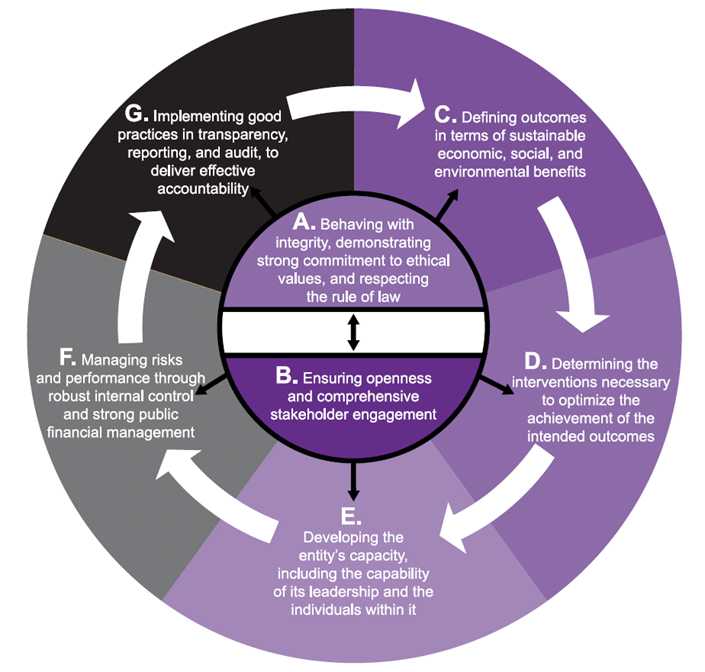
Diagram that explains the steps of the local code of corporate governance and how it flows.

Status, ownership, and review

This Local Code of Corporate Governance is a core component of Maidstone Borough Council’s overall governance and assurance framework. It underpins the Council’s statutory Annual Governance Statement, which is published alongside the Statement of Accounts and provides an annual assessment of the effectiveness of the Council’s governance arrangements.

The Code applies to:

  • all Members of the Council;
  • all officers; and
  • governance arrangements relating to partnerships, shared services and other delivery arrangements where the Council has responsibility or accountability

Responsibility for maintaining and embedding the Code sits with the Council’s statutory officers and senior management, working collectively to ensure that governance arrangements remain robust, proportionate and effective.

The effectiveness of the Council’s governance framework, as set out in this Code, is reviewed annually. This review:

  • assesses the extent to which the principles of good governance have been applied;
  • considers evidence from internal and external sources of assurance, including audit, scrutiny and performance reporting; and
  • identifies any governance issues or areas for improvement

The outcome of the annual review informs the preparation of the Annual Governance Statement, including any action plan required to address identified weaknesses or to strengthen governance arrangements further.

The Code itself is reviewed  annually and updated as necessary to reflect:

  • changes in legislation or statutory guidance;
  • developments in best practice in local government governance; and
  • changes to the Council’s governance structures or operating environment

Oversight of the Code and the Annual Governance Statement is provided through the Council’s established audit and governance arrangements, ensuring appropriate Member scrutiny and independent challenge.

Annual review and reporting

To comply with the principles of good governance, we must ensure that systems and processes are continually monitored and kept up to date. An annual review of the Council’s Corporate Governance arrangements will be carried out using the guidance contained in the CIPFA/SOLACE Framework.

The purpose of the review will be to provide assurance that governance arrangements are adequate and operating effectively, or to identify action that is planned to ensure effective governance in the future. The results of the review will take the form of an Annual Governance Statement prepared on behalf of the Leader of the Council and the Chief Executive. It will be submitted to the Audit, Governance and Standards Committee for consideration and review.

Annual review of governance

Our actions and behaviours

Principle A - Behaving with integrity, demonstrating strong commitment to ethical values, and respecting the rule of law

Sub principle Actions and behavioursEvidence
Behaving with Integrity
  • We ensure that councillors and officers behave with integrity and lead a culture where acting in the public interest is visibly and consistently demonstrated thereby protecting the reputation of the organisation.
  • We ensure that councillors take the lead in establishing values for the organisation and its staff and that they are communicated and understood. Building on the Seven Principles of Public Life (the Nolan Principles).
  • We lead by example and include integrity as one of our corporate values on our competency framework.
  • We demonstrate, communicate and embed the values through appropriate policies and processes which are reviewed on a regular basis to ensure that they are operating effectively.
  • Councillor Code of Conduct and training for Councillors on the code included in induction.
  • Officer Code of Conduct.
  • Constitution.
  • Complaints Procedure and Annual Report.
  • Counter Fraud and Corruption Policy & Strategy.
  • Equalities Policy.
  • Whistle-blowing charter.
  • Corporate Values - we work together, respect everyone, develop and grow, make a difference and care.
  • Internal Staff Surveys.
  • One-to-one evidenced on clear review with documented targets and deadlines and actions.
  • Democracy and General Purposes Committee reports, minutes and meetings.
  • Audit Governance and Standards Committee reports, minutes and meetings.
  • Overview and Scrutiny Committee reports, minutes and meetings.
  • Staff Handbook, Induction and Values.
  • Emergency Plan and Business Continuity Plans.
  • Artificial Intelligence Policy.
  • Professionally qualified staff and training to maintain CPD.
Demonstrating strong commitment to ethical values
  • We establish, monitor and maintain the organisation’s ethical standards and performance.
  • We underpin personal behaviour with ethical values and ensuring they permeate all aspects of the organisation’s culture and operation.
  • We develop and maintain robust policies and procedures which place emphasis on agreed ethical values.
  • We ensure that external providers of services on behalf of the organisation are required to act with integrity and in compliance with ethical standards expected by the organisation.
  • Corporate Strategy and Annual Action Plan.
  • Constitution.
  • Human Resources Policies.
  • Staff Handbook.
  • Corporate Values promoted via team talks and staff awards.
  • Induction Process.
  • Register of Interests.
  • Register of gifts and hospitality.
  • Staff and Managers’ Forums.
  • Equalities Policy.
  • Whistle-blowing Policy.
  • Contract Procedure Rules.
Respecting the rule of law
  • We ensure councillors and staff demonstrate a strong commitment to the rule of the law as well as adhering to relevant laws and regulations.
  • We create the conditions to ensure that the statutory officers, other key post holders, and members, are able to fulfil their responsibilities in accordance with legislative and regulatory requirements.
  • We strive to optimise the use of the full powers available for the benefit of residents, communities and other stakeholders.
  • We deal with breaches of legal and regulatory provisions effectively.
  • We ensure corruption and misuse of power are dealt with effectively.
  • Monitoring Officer Role.
  • Internal Audit.
  • External Auditors.
  • Complaints process. including referral to the Local Government Ombudsman.
  • Audit, Governance and Standards Committee.
  • Appraisals for Chief Executive and Directors and Regular Monthly Check-ins with all staff using clear review.
  • Code of Conduct for Councillors and Officers.
  • Counter fraud and Corruption Policy.

Principle B - Ensuring openness and comprehensive stakeholder engagement

Sub principleActionsEvidence
Openness
  • We ensure an open culture through demonstrating, documenting and communicating the organisation’s commitment to openness.
  • We make decisions that are open about actions, plans, resource use, forecasts, outputs and outcomes.
  • We provide clear reasoning and evidence for decisions in both public records and explanations to stakeholders and being explicit about the criteria, rationale and considerations used. In due course, ensuring that the impact and consequences of those decisions are clear.
  • We use formal and informal consultation and engagement to determine the most appropriate and effective interventions/courses of action.
  • Corporate Strategy and Annual Action Plan.
  • Communication and Engagement Strategy.
  • Committee work programmes, agenda and minutes.
  • Council Website.
  • Formal consultation processes.
  • Deliberative Engagement on priority topics including Violence Against Women and Girls.
  • Community and voluntary sector representation on Partnership Boards.
  • Freedom of Information publication scheme.
  • Report Templates include options appraisal, risk and consultation.
  • Staff and Councillor Codes of Conduct.
  • Access to Information Procedure Rules.
  • Part II Guidance for Officers for confidential and exempt reports.
  • Public interest test application.
  • Forward Plan produced for all Cabinet Decisions.
  • Follow statutory transparency requirements.
  • Complaints report and trend analysis.
Engaging comprehensively with institutional stakeholders
  • We effectively engage with institutional stakeholders to ensure that the purpose, objectives and intended outcomes for each stakeholder relationship are clear so that outcomes are achieved successfully.
  • We develop formal and informal partnerships to allow for resources to be used more efficiently and outcomes to be achieved more effectively.
  • We define the purpose, objectives and intended outcomes for each stakeholder relationship.
  • We use formal and informal consultation and engagement to determine the most appropriate and effective interventions.
  • Safer Maidstone Partnership and Strategy and Action Groups.
  • Healthy Alliance Partnership.
  • Community Safety Team.
  • Consultation processes.
  • Council Website – Let’s Talk Maidstone.
  • Anchor Institutions Meeting and Regular Communication.
  • Inclusion Board.
  • Quarterly meetings with KCC.
  • Kent Safeguarding Children Multi- Agency Partnership.
  • Kent and Medway Safeguarding Adults Board.
Engaging stakeholders effectively, including individual citizens and service users
  • We establish a clear policy on the type of issues that the organisation will consult with or involve individual citizens, service users and other stakeholders to ensure that service (or other) provision is contributing towards the achievement of intended outcomes.
  • We ensure that communication methods are effective and members and officers are clear about their roles with regard to community engagement.
  • We encourage, collect and evaluate the views and experiences of communities, residents, businesses, service users and organisations of different backgrounds, including reference to future needs.
  • We have a feedback mechanism to demonstrate how their views have been taken into account.
  • We balance feedback from more active stakeholder groups with other stakeholder groups to ensure inclusivity
  • We take into account of the interests of future generations of taxpayers and service users.
  • Corporate Strategy and Action Plan published on website.
  • Communications and Communication and Engagement Strategy.
  • Borough Insight.
  • Deliberative Engagement.
  • External Auditor provides an annual organisational assessment of the Council’s performance through the Value for Money conclusion.
  • Council Website.
  • Council meetings, minutes and agendas available on website.
  • Formal consultation arrangements.
  • Community and voluntary sector representation on Partnership Boards.
  • Satisfaction Surveys.
  • Freedom of Information publication scheme.
  • Statement of Community Involvement.
  • Local Plan.

Principle C - Defining outcomes in terms of sustainable economic, social, and environmental benefits

Sub principleActionsEvidence
Defining Outcomes
  • We have a clear vision which is an agreed formal statement of the organisation’s purpose and intended outcomes containing appropriate performance indicators, which provides the basis for the organisation’s overall strategy, planning and other decisions.
  • We specify the intended impact on, or changes for, stakeholders including residents, businesses and service users.
  • We deliver defined outcomes on a sustainable basis within the resources that will be available.
  • We identify and manage the risks to the achievement of outcomes.
  • We manage service users’ expectations effectively with regard to determining priorities and making the best use of the resources available.
  • Corporate Strategy and Year 2 Action Plan.
  • Committee work programmes.
  • Cabinet Forward Plan.
  • Corporate report template requires information explaining the legal, environmental, social and financial implications of decisions.
  • Community Safety Team.
  • Housing Strategy.
  • Waste Strategy.
  • 10 Year Parks Plan.
  • Biodiversity and Climate Change Strategy and Action Plan.
  • Temporary Accommodation Strategy.
  • Risk Management Framework & processes for identifying and managing risk.
  • Regular consideration of risk by Cabinet and the Audit, Governance and Standards Committee.
  • The corporate report template contains ‘risk implications’.
  • Staff Survey.
Sustainable economic, social and environmental benefits
  • We consider and balance the combined economic, social and environmental impact of policies, plans and decisions when taking decisions about service provision.
  • We take a longer-term view with regard to decision-making, taking account of risk and acting transparently where there are potential conflicts between the organisation’s intended outcomes and short-term factors such as the political cycle or financial constraints.
  • We determine the wider public interest associated with balancing conflicting interests between achieving the various economic, social and environmental benefits, through consultation where possible, in order to ensure appropriate trade-offs.
  • We ensure equality of access.
  • Corporate Strategy.
  • Committee work programmes.
  • Formal consultation arrangements.
  • Economic Development Strategy.
  • Medium Term Financial Strategy.
  • Safer Maidstone Strategy.
  • Local Plan.
  • Waste and Recycling Strategy.
  • Health and Wellbeing Action Plan.
  • Equality Policy.
  • Biodiversity and Climate Change Working Group.

Principle D – Determining the interventions necessary to optimise the achievement of the intended outcomes

Sub principleActionsEvidence
Determining interventions
  • We ensure decision makers receive objective and rigorous analysis of a variety of options, indicating how intended outcomes would be achieved and include the risks associated with those options.
  • We ensure the best value is achieved; however, services are provided.
  • We consider feedback from citizens and service users when making decisions about service improvements or where services are no longer required in order to prioritise competing demands within limited resources available, including people, skills, land and assets and bearing in mind future impacts.
  • Corporate report template requires information explaining the legal and financial implications of decisions.
  • Options appraisal included in all committee and Cabinet reports for decision.
  • Assessment of Social, Environmental and Financial Implications in reports.
  • Financial, legal and technical advice provided by the s151 Officer, the Monitoring Officer and other officers as required.
  • Council Website.
  • Consultation processes.
  • Quarterly performance management reports.
Planning interventions
  • We establish and implement robust planning and control cycles that cover strategic and operational plans, priorities and targets.
  • We engage with internal and external stakeholders in determining how services and other courses of action should be planned and delivered.
  • We consider and monitor risks facing each partner when working collaboratively, including shared risks.
  • We ensure arrangements are flexible and agile so that the mechanisms for delivering outputs can be adapted to changing circumstances.
  • We establish appropriate key performance indicators (KPIs) as part of the planning process in order to identify how the performance of services and projects is to be measured.
  • We ensure capacity exists to generate the information required to review service quality regularly.
  • We prepare budgets in accordance with organisational objectives, strategies and the medium-term financial plan.
  • We inform medium and long-term resource planning by drawing up realistic estimates of revenue and capital expenditure aimed at developing a sustainable funding strategy.
  • Corporate Planning Timetable.
  • Corporate Strategy.
  • Service Plans.
  • Quarterly Monitoring Reports.
  • Corporate Strategy Annual Plan and regular reporting.
  • Contract Monitoring Arrangements.
  • Performance Reports aligned to Strategic Plan priorities.
  • Medium Term Financial Strategy.
  • Capital Programme.
  • Value for Money. judgement by the External Auditor.
Optimising achievement of intended outcomes
  • We ensure the medium-term financial strategy integrates and balances service priorities, affordability and other resource constraints.
  • We ensure the budgeting process is all-inclusive, taking into account the full cost of operations over the medium and longer term.
  • We ensure the medium-term financial strategy sets the context for ongoing decisions on significant delivery issues or responses to changes in the external environment that may arise during the budgetary period in order for outcomes to be achieved while optimising resource usage.
  • We ensure the achievement of ‘social value’ through service planning and commissioning.
  • Medium Term Financial Strategy.
  • Revenue budget process.
  • Capital Programme.
  • Procurement Policy.
  • Procurement Standing Orders.
  • Action Plans developed in response to external audit and inspections.
  • Value for Money judgement by the external auditor.
  • Budget Consultation.

Principle E - Developing the entity’s capacity, including the capability of its leadership and the individuals within it

Sub principleActionsEvidence
Developing the entity’s capacity
  • We review operations and performance on a regular basis to ensure their continuing effectiveness and enable organisational learning.
  • We improve resource use through the appropriate application of techniques such as benchmarking and other options in order to determine how the authority’s resources are allocated so that outcomes are achieved effectively and efficiently.
  • We recognise the benefits of partnerships and collaborative working where added value can be achieved.
  • Corporate Planning Timetable.
  • Budget Setting Process.
  • Service Plans.
  • Regular one-to-ones and reviews of development and training needs.
  • Developing the Everybody Competency Framework is used to identify top performers for stretch.
  • Mid Kent Services Partnership.
  • Learning and Development Programme.
  • Standing arrangement with temporary staffing providers to help manage fluctuations in capacity demand.
Developing the capability of the entity’s leadership and other individuals
  • We clarify the roles and responsibilities of members and management at all levels.
  • We develop protocols to ensure that elected and appointed leaders negotiate with each other regarding their respective roles early on in the relationship and that a shared understanding of roles and objectives is maintained.
  • We publish a statement that specifies the types of decisions that are delegated and those reserved for the collective decision-making of the governing body.
  • We ensure the Leader and the Chief Executive have clearly defined and distinctive leadership roles.
  • We develop the capabilities of members and senior management to achieve effective shared leadership and to enable the organisation to respond successfully to changing legal and policy demands as well as economic, political and environmental changes and risks.
  • We ensure that there are structures in place to encourage public participation.
  • We hold staff to account through regular performance reviews which take account of training or development needs.
  • We ensure arrangements are in place to maintain the health and well-being of the workforce and support individuals in maintaining their own physical and mental well-being.
  • Job descriptions and person specifications were produced for all posts.
  • Recruitment and appointment policies and procedures.
  • Manager onboarding and training programme.
  • Informal Cabinet Meetings
  • Councillor workshops and briefings.
  • Democracy and General Purposes Committee review of Member Training.
  • Comprehensive learning and development programme for officers and councillors.
  • Corporate Workforce Strategy.
  • Staff surveys.
  • HR Policies and Guidance on the intranet.
  • Member and Staff Induction.
  • Check-ins held monthly with staff.
  • Annual Health and Wellbeing week and regular updates to staff.

Principle F - Managing risks and performance through robust internal control and strong public financial management

Sub principleActionsEvidence
Managing Risk
  • We recognise that risk management is an integral part of all activities and must be considered in all aspects of decision-making.
  • We implement robust and integrated risk management arrangements and ensure that they are working effectively.
  • We ensure that responsibilities for managing individual risks are clearly allocated.
  • Risk Management Framework & outline processes for identifying and managing risk. Strategic Risk Register in place and reviewed by the Leadership team.
  • Directorate and service-level risk registers in place and reviewed monthly.
  • The corporate report template contains ‘risk implications’
  • Audit Governance and Standards Committee reviews risks regularly.
  • Corporate Services PAC regularly reviews all high-risk.
  • All risks are assigned a risk owner responsible for managing the risk.
  • Cybersecurity, meeting cyber essentials accreditation and testing outcomes, for example, phishing simulations.
  • Internal Audit Reviews.
Managing Performance
  • We monitor service delivery effectively, including planning, specification, execution and independent post-implementation review.
  • We make decisions based on relevant, clear, objective analysis and advice, pointing out the implications and risks inherent in the organisation’s financial, social and environmental position and outlook.
  • We ensure an effective scrutiny or oversight function is in place which encourages constructive challenge and debate on policies and objectives before, during and after decisions are made thereby enhancing the organisation’s performance and that of any organisation for which it is responsible.
  • We provide members and senior management with regular reports on service delivery plans and on progress towards outcome achievement.
  • We ensure there is consistency between specification stages (such as budgets) and post-implementation reporting (e.g. financial statements).
  • Performance Reports aligned to priorities.
  • Performance Dashboards.
  • Quarterly Monitoring Reports.
  • Contract Monitoring Reports.
  • Risk-Based Internal Audit Planning.
  • A corporate report template requires information explaining the legal and financial implications of decisions.
  • The corporate report template contains risk implications.
  • Monthly spend/budget reports sent to all budget holders.
  • Quarterly workforce reports.
Robust Internal Control
  • We align the risk management strategy and policies on internal control with achieving the objectives.
  • We evaluate and monitor the authority’s risk management and internal control on a regular basis.
  • We ensure effective counter-fraud and anti-corruption arrangements are in place.
  • Ensure additional assurance on the overall adequacy and effectiveness of the framework of governance, risk management and control is provided by the internal auditor.
  • We ensure the Audit, Governance and Standards Committee, which is independent of the decision-making committees, provides further assurance regarding arrangements for managing risk and maintaining an effective control environment.
  • Risk Management Policy & Guide in place and reviewed annually.
  • Corporate Risk Register in place and reviewed by the Leadership team.
  • Service level risk registers are in place.
  • Counter Fraud and Corruption Policy.
  • Audit Governance and Standards Committee reviews the effectiveness of risk arrangements.
  • Corporate Services PAC regularly reviews all high-risk.
  • Annual audit opinion from the Head of Internal Audit giving an opinion on the systems of internal control, governance and risk management.
  • Corporate Information Management and Governance Groups.
Managing Data
  • We ensure effective arrangements are in place for the safe collection, storage, use and sharing of data, including processes to safeguard personal data.
  • We regularly review and audit the quality and accuracy of the data used in decision-making and performance monitoring.
  • We ensure that effective arrangements for sharing data with other bodies are in place.
  • Communication and Engagement Strategy.
  • Information Management Group and action plan.
  • Freedom of Information publication scheme.
  • Ongoing monitoring of Data Protection Act / Freedom of Information compliance.
Strong public financial management
  • We ensure financial management supports both long-term achievement of outcomes and short-term financial and operational performance.
  • We ensure well-developed financial management is integrated at all levels of planning and control, including management of financial risks and controls.
  • Corporate Strategy.
  • Medium Term Financial Strategy.
  • Budget setting process.
  • Procurement Policy.
  • Procurement Standing Orders.
  • Value for Money judgement from the External Auditor.
  • External Auditors’ Annual Audit Letter.

Principle G – Implementing good practices in transparency, reporting, and audit to deliver effective accountability

Sub principleActionsEvidence
Implementing good practice in transparency
  • Write and communicate reports for the public and other stakeholders in an understandable style appropriate to the intended audience, ensuring they are easy to access and interrogate.
  • Strike a balance between providing the right amount of information to satisfy transparency demands and enhance public scrutiny, while not being too onerous to provide and for users to understand.
  • Council website accessibility statement.
  • Communications and Community Engagement Strategy.
  • Budgets and spending are published on the website.
  • Senior Officer remuneration is published on the website.
  • Clear roles and responsibilities in relation to access to information in the Constitution.
  • Annual Governance Statement Action Plan monitored.
Implementing good practices in reporting
  • We report at least annually on performance, value for money and the stewardship of its resources.
  • We ensure members and senior management own the results.
  • We assess the extent to which the principles contained in the Framework have been applied and publish the results of this assessment, including an action plan for improvement and evidence to demonstrate good governance in action.
  • We ensure that the Framework is applied to jointly managed or shared service organisations as appropriate.
  • We ensure the performance information that accompanies the financial statements is prepared on a consistent and timely basis, and the statements allow for comparison with other similar entities.
  • Publication of the Annual Report and Statement of Accounts on the website.
  • Annual Governance Statement produced and published on the website.
  • Local Code of Corporate Governance is refreshed annually in accordance with CIPFA/SOLACE principles.
  • Documents are scrutinised and approved by the Leadership Team, Service Committees and Audit Committee prior to publication.
  • Performance information and reports are published on the website and reported to the Committees.
Assurance and effective accountability
  • We ensure that recommendations for corrective action made by the external audit are acted upon.
  • We ensure an effective internal audit service with direct access to members is in place which provides assurance with regard to governance arrangements and recommendations are acted upon.
  • We welcome peer challenge, reviews and inspections from regulatory bodies and implementing recommendations.
  • We gain assurance on risks associated with delivering services through third parties, and this is evidenced in the Annual Governance Statement.
  • We ensure that when working in partnership, arrangements for accountability are clear and that the need for wider public accountability has been recognised and met.
  • The external auditors produce an Annual Audit Letter which is presented at Audit Committee and published on the website. The council produces a response to all issues and recommendations contained within.
  • Internal control, risk management and governance processes.
  • The Head of Audit Partnership presents an annual report to the Audit, Governance, and Standards Committee to inform members of Internal Audit activity that has taken place during the year, as well as an Annual Audit Opinion.
  • Annual Governance Statement produced and published on the website.
  • Risk-based internal audit plan, with progress regularly reported to the management team and members.
  • Follow-up work on actions raised by internal auditors was reported to members.